General Caine was summarily ignored for his input, which, of course, ran contrary to the Jared Kushners, Marco Rubios, and Steve Witkoffs in the room. So what happened, and where are we? Let's break it down. As usual, we will do our best to keep it completely factual, without opinion. Although this is primarily a music blog, I like to break down important events, when possible, just to leave some sort of record that is not susceptible to the Orwellian memory hole that seems to be gaining power by the day.
The Timeline
These events began on the morning of Saturday, February 28th, 2026.
Event 1 — The Opening Strike
The US and Israel launch a coordinated, large-scale strike inside Iran. Over 1,000 Iranian targets are struck. Senior IRGC and military leadership are killed. Iran's Supreme Leader Ali Khamenei is assassinated. Missile infrastructure and air defenses are destroyed. Naval assets are sunk. Sites near nuclear facilities are hit. The conflict is described as moving "instantly from shadow war to declared interstate war."
Event 2 — Iran Retaliates
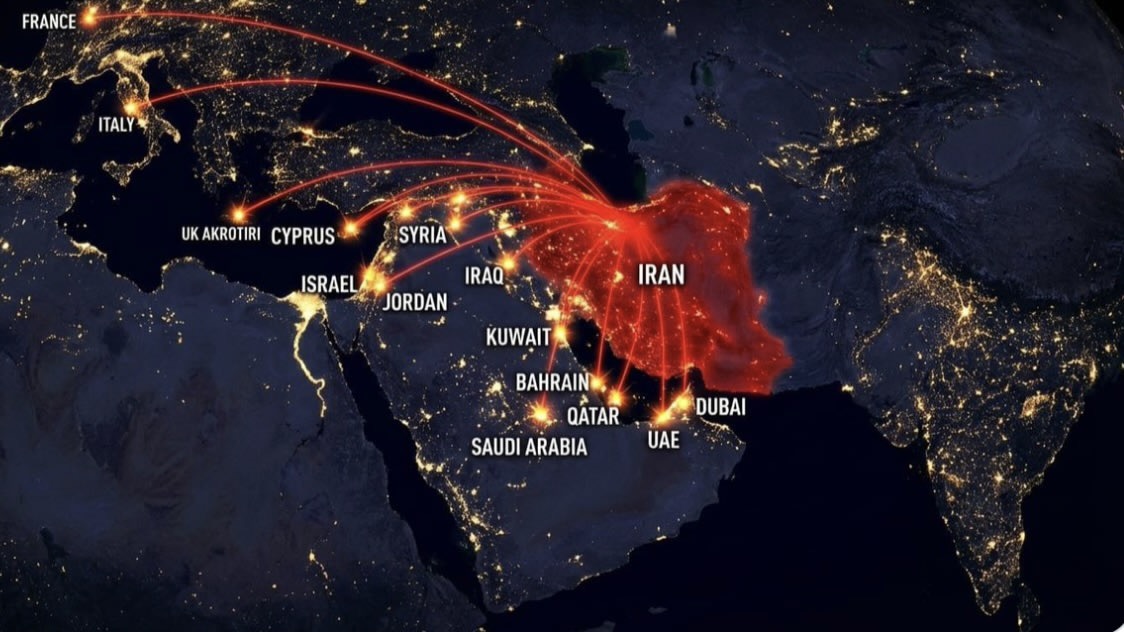
Iran launches ballistic missile barrages at Tel Aviv, Jerusalem, and central and northern Israel. Drone and missile attacks are launched against UAE, Qatar, Kuwait, Bahrain, and US bases in Iraq. Attacks occur near Dubai airport and Gulf infrastructure. Civilian casualties are reported in Israel and the Gulf. Iran attempts to halt shipping near the Strait of Hormuz. Oil markets spike. Airspace closures follow.
Event 3 — Hezbollah Enters from Lebanon
Hezbollah launches rockets and drones into Northern Israel, opening a second front. Israel responds with widespread strikes across Lebanon. The Hezbollah leader is assassinated in Beirut. Israeli leadership declares the war will not end until Hezbollah's threat is eliminated. Evacuation warnings are issued in southern Lebanon. Lebanese civilian casualties mount.
Event 4 — The War Spreads Geographically
Qatar intercepts and shoots down 2 Iranian fighter jets — described as the first confirmed aerial combat between Iran and Gulf states. Gulf states more broadly intercept missiles and drones. A British RAF airbase in Cyprus is struck by a drone. US forces suffer casualties. Explosions are reported near Iranian nuclear facilities in Isfahan. Shipping disruptions continue in the Strait of Hormuz. The US signals a larger "wave" of strikes is still coming and does not rule out ground troops.
Event 5 — Internal Restructuring in Iran
Following Khamenei's assassination, a temporary leadership council assumes authority. Gen. Ahmad Vahidi is appointed as the new IRGC commander. Ali Larijani publicly denies Iran has approached the US for renewed nuclear negotiations. A new Supreme Leader is expected to be selected within days. Iran signals regime stability — no sign of political collapse or surrender.
Event 6 — Competing Claims Emerge
Iranian state media (Tasnim News Agency) reports that Israel, not Iran, carried out the attack on the Saudi Aramco Ras Tanura oil refinery in Saudi Arabia. Qatar and Saudi Arabia reportedly arrest Mossad agents allegedly planning to detonate bombs to "create havoc." Israel's UN envoy states the war will last "as long as it takes."
Commentary
The impact on oil supplies around the world, along with downline consequences for countries that primarily import fuel for energy generation, cannot be underestimated. Iran has made a calculated decision to employee a double-pronged approach in response to the belligerence of US & Israel: on the one hand, a sort of scorched earth policy with regard to US Allies in the region that is intended to hit Gulf states directly in their pocketbooks, while also offering swift retribution to the US military bases in Qatar, Kuwait, UAE, and elsewhere that seems to have taken US forces by surprise, and is meant to degrade their ability to wage continued war. It is entirely possible that the real numbers in terms of US casualties, as well as the extent of damage to costly infrastructure like the AN/FPS-132 early-warning radar system in Qatar, will not be forthcoming, or will be perhaps obfuscated indefinitely. The unfortunate truth here is that unless and until Gulf state players like Saudi Arabia and UAE leverage their connection with the Trump administration to bring this thing to a halt, it's not clear that anyone in the current administration has the ability to put the proverbial fart back in the bag.
It's no secret that the state of Israel has lobbied every president since Jimmy Carter to carry out a preemptive regime change operation in Iran, so none of this is new. It's just that the Trump administration is the first one to take the bait, and they probably have a number of reasons for this. Among them is a distraction from the ongoing Epstein investigation, along with a cabinet that has actively sought to exclude senior officials with views that are in conflict with this administration's hawkish goals with respect to statecraft.
There are no winners here. If it was ever true that the Iranian people would be open to a US-led regime change, that door is now closed. The entire country of Iran seems to be rallying around the symbolism of Khamenei as a martyr, and Trump said himself that the initial strike was so successful that all of the intended successors are dead.
Trump says US had identified candidates to take over Iran but they were killed in initial strikes
So here we are, embroiled yet again in a war for nothing. To the world: I'm so sorry. It's very hard to see a way out of this that does not involve more death and destruction. But, God willing, we will find it.